
As the seasons shift… from summer’s warmth to the crisp, cool air of fall, many…
For over two millennia…
Traditional Chinese Medicine (TCM) has described a network of channels (meridians) and points through which the body’s vital energy, Qi, flows. To some, this has seemed abstract or mystical. But according to a 2022 biophysical model published in Medical Acupuncture by Clare Foley and Gerhard Litscher, the ancient Chinese anatomists were describing something very real: your neurovascular system.
Let’s explore how classical TCM knowledge aligns with cutting-edge cardiovascular science.
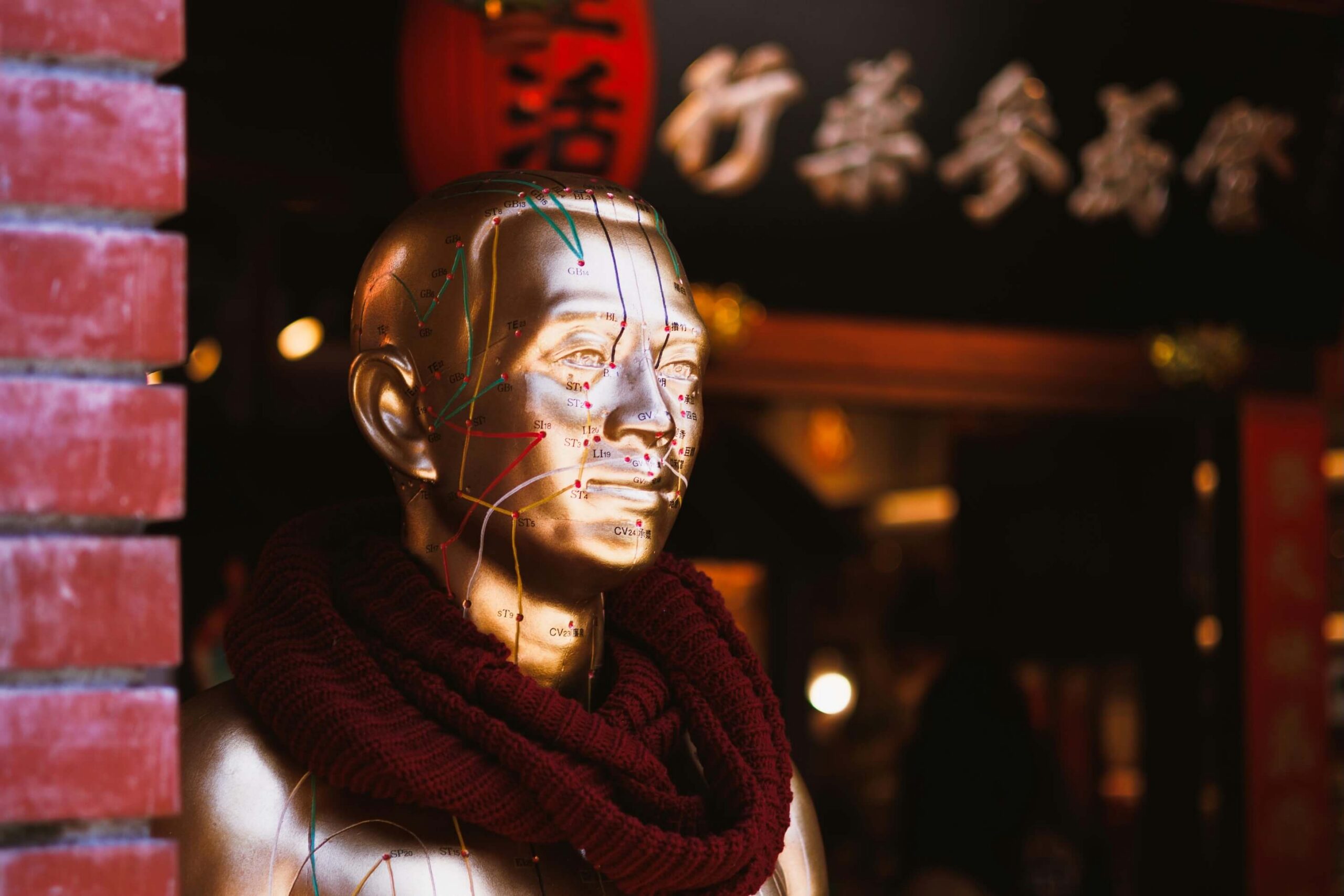
The Ancient Anatomists Were Right
Far from being purely philosophical, the foundational text of acupuncture, the Huang Di Nei Jing Ling Shu (HDNJLS), written in the second and first centuries BCE, was based on actual dissection. The text states:
Let us take a male person… he may be dissected to observe his [interior appearance]… of what length the vessels are, whether the blood is clear or turbid… all this can be quantified. A treatment with needles and moxibustion always serves to regulate the qi in the conduits. (HDNJLS Ling Shu, Chapter 12)
For sociopolitical reasons, in-depth anatomical investigations became taboo after the Han dynasty (c. 220 AD). From then on, knowledge was based on written texts and external observation. But the original descriptions were clear: the “conduit vessels” (JingMai) and “network vessels” (LuoMai) are physical structures.
The authors of the HDNJLS distinguished between vessels carrying blood (visible, firm, large) and vessels carrying Qi (fine, deep). Modern researchers now interpret this as the distinction between blood vessels and nerves, grouped together as one neurovascular system.
Acupuncture Points Are Neurovascular Branching Loci
According to the HDNJLS, acupoints are not random. Chapter 1 states:
Of the conduit vessels there are 12. Of the network vessels there are 15. The joints where [these structures] intersect, they constitute 365 meeting points.
These “meeting points” are where nerves and blood vessels branch. Modern dissections have confirmed that acupoint names often refer to anatomical details visible only when skin and fat are removed, exactly what the ancient anatomists would have seen.
Some of the most powerful points, called “transport openings” in the HDNJLS, are located below the elbows and knees at major neurovascular branchings. Examples include Neiguan (P-6) along the median nerve in the arm, and Zusanli (ST-36) at the trifurcation of the deep peroneal nerve in the leg.
What Acupuncture Actually Does to Your Body
When a needle stimulates these branching points, three major cardiovascular effects occur, according to the biophysical model:
- Acupuncture Increases Microcirculation
Acupuncture triggers a local “axon-reflex” response, a signal that travels along nerve bundles and causes blood vessels to dilate (expand). This increases blood flow not only at the needle site but also in distant regions. For example, needling the hand point Hegu (LI-4) increases facial blood perfusion.
Even more fascinating, acupuncture can increase blood flow on the opposite side of the body at the mirror point, suggesting that the nervous system mediates a whole-body response.
- Acupuncture Regulates Blood Pressure
Acupuncture acts on the autonomic nervous system, the part of your body that controls heart rate and blood vessel constriction without you thinking about it. The direction of effect depends on your baseline state: if you have high blood pressure, acupuncture lowers it; if you have low blood pressure, it raises it. In healthy individuals, it maintains normal pressure.
This occurs because acupuncture influences key brain regions, the hypothalamus, brainstem nuclei like the NTS (nucleus tractus solitarii), and the RVLM (rostral ventrolateral medulla), that control blood pressure.
- Acupuncture Organizes Heart Rate Variability (HRV)
This is where ancient and modern thinking beautifully converge. Traditional measures of HRV (like sympathetic/parasympathetic balance) often show no change with acupuncture. But when researchers used nonlinear analysis, which respects the fact that the heart is a complex, chaotic system, a different picture emerged.
Acupuncture increases the complexity of heartbeats while decreasing randomness. Healthy hearts operate in a “window of organized variability” not too periodic (like heart failure) and not too random (like atrial fibrillation). Acupuncture appears to tighten heartbeats around healthy set-points, returning the body to a state of adaptive balance.
This aligns perfectly with the TCM concept of balance and the Five Phases creation/destruction cycle, where each organ system modifies and is modified by every other.
Two Key Mechanisms: Ascending Vasodilation and Baroreflex Resetting
The model proposes two interconnected physiological processes:
Ascending Vasodilation (AVD): Blood vessels can carry a dilatory signal along their inner lining (endothelium) without needing instructions from the brain. Normally, sympathetic nerves counteract this dilation. But during acupuncture, with the patient lying still, that counteraction is minimal, allowing vasodilation to spread unimpeded up entire branches of the vascular tree.
Baroreflex Resetting: The baroreflex is your body’s feedback loop that maintains stable blood pressure. During exercise, it resets to a higher pressure range. During acupuncture, a partial reset occurs, muscle afferents are activated as if preparing for movement, but without actual muscle contraction. This unique state allows cardiovascular set-points to be recalibrated without the energy cost of exercise.
Why Branch Points Matter
In TCM, points where vessels diverge are considered powerful treatment locations. Biophysics explains why: when a blood vessel splits into two, blood flow and nerve signaling must change. These junctions are ideal for influencing the entire feedback network of the neurovasculature.
The famous “Four Gates” combination (Hegu LI-4 on the hand and Taichong LV-3 on the foot) targets the most peripheral anastomoses, bridging vessels that connect arteries on either side of the hands and feet. Extensive vasodilation and blood flow redistribution here may be a key contributor to acupuncture’s pain-relieving effects.
Conclusion: Ancient Knowledge, Modern Validation
The Huang Di Nei Jing Ling Shu described a body of interconnected conduits and network vessels, with 365 meeting points at their intersections. Modern biophysics has now shown that:
- Those conduits are your neurovasculature (nerves and blood vessels)
- Those meeting points are branching loci
- Stimulating them increases microcirculation, regulates blood pressure, and organizes heart rate patterns
- The underlying mechanisms, ascending vasodilation and baroreflex resetting, follow known physical laws
As Foley and Litscher conclude, “The outline of a model of acupuncture mechanism is emerging that centers around… known processes.” The ancient Chinese anatomists, working 2,200 years ago with dissection and observation, described a system that modern science is only now beginning to fully understand.
Acupuncture does not manipulate mysterious energy. It engages the physical, electrical, and vascular architecture of your body, using branch points designed by nature to communicate change from the periphery to the core.
Source:
Foley C, Litscher G. A Biophysical Model for Cardiovascular Effects of Acupuncture—Underlying Mechanisms Based on First Principles. Medical Acupuncture. 2022;00(00):1-18. DOI: 10.1089/acu.2022.0050

Related Posts


Comments (0)